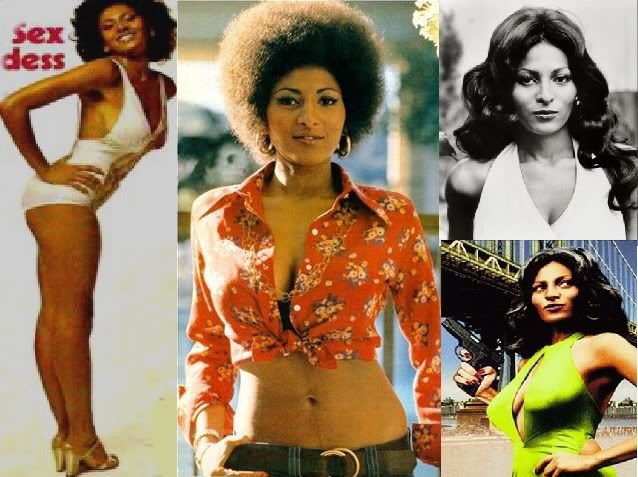
Blaxploitation Film Icon Pam Grier

Blaxploitation Film Icon Pam Grier
Image of film icon Pam Grier courtesy of PhotoBucket (www.photobucket.com)
Showing posts with label black feminism. Show all posts

Tuesday, October 5, 2010

Black Sexual Politics

Collins, Patricia Hill. 2004. Black Sexual Politics. New York: Routledge Press

Patricia Hill Collins follows up her previous work on black feminism with a book examining race and gender and how images of black sexuality have been used to further a divide between black men and women as well as reinforcing racist ideals on a global scale.  Collins examines current media (videos, film, and literature) and American culture to define how blacks (male and female) are sexualized and categorized based on stereotypes that are the antithesis of the ideal “white purity”. Collins defines this work as relying heavily on discourse analysis (4-5) to define the specifics of gender-based racism. Collins is methodical in her approach to the subject, drawing on her familiar lens of black feminism as well as sociological theories as it relates to gender, race and political implications.

I wanted to familiarize myself with other works by Collins and Black Sexual Politics also seemed like a natural fit to draw theory from for the type of theoretical “slant” in which I wanted to take my research project. With specific correlation to my project, Collins talks about the use of black women in 1970s blaxploitation film as either “sexual props” to black male heroes or in the case of Pam Grier, a “combination of beauty, sexuality and violence” (124). The conflict arises in the interpretation of the black female audience of Grier (and other blaxploitation female lead actors) to her portrayal of a black woman on screen? Is she what Collins calls a “black bitch” (125) or just asserting her authority in a male dominated celluloid world? Is Grier’s character authentic or contrived?  Furthermore, would modern, “Generation X” black women perceive characters such as Grier’s “Foxy Brown” or Dobson’s “Cleopatra Jones” in the same light?

Monday, October 4, 2010

What’s in a Name?: Womanism, Black Feminism, and Beyond

Collins, Patricia Hill . 1996. “What’s in a Name?: Womanism, Black Feminism, and Beyond”.  The Black Scholar.  26(1): 9-17.

Noted black feminist scholar Patricia Hill Collins seeks to define and specify the terms in which black women can define their unique experiences and scholarly.  In the scholarly community there is great debate on which terms are all encompassing to the African-American female experience. Is it womanism (as defined by Alice Walker), black feminism, or simply part of the greater feminist experience? As Collins notes, most African-American women see no great different between the two terms as both terms are concerned with the intersection of racism and sexism (10).  Collins explores both terms and the theoretical implications (both negative and positive) of their use to define the viewpoint of black women. As defined by Collins (using Alice Walker’s previous definitions), “womanism” is the theory of the black woman’s experience which is concrete in the history of racial and gender oppression specific to African-American women while “black feminism” is more global ideology and encompassing social, sexual, political and economic issues that impact black women (12).  Both terms try to define the experience of black women outside of the terms of “feminism” which traditionally has been seen as a “movement for and about white and lesbian women”  (15), which remains problematic for black women. Collins argues that the debate should shift from issues of naming to how overlapping themes can be used for the greater good of drawing attention to issues concerning black women.

Collins’s definitions of both terms have been helpful in shaping my own lens within my own research. For the purposes of my research project, I choose to use the term “black feminism” in defining the ideology and theoretical approach I want to take in my assessment of blaxploitaiton. I take this stance mainly because I am dealing with the medium of film: a globally accessible item that can be viewed by black women across the Diaspora. Furthermore, I believe by examining films I can raise issues that are uniquely both important to feminist theory and important to discussions on race and gender; therefore, a unique juxtaposition between race and gender is at work in blaxploitaiton films. In addition, there appears to be more familiarity with the term “black feminist” than with the term “womanism”.

The Returns of “Cleopatra Jones"

Brody, Jennifer DeVere. 1999 The Returns of “Cleopatra Jones".  Signs:  Journal of Women in Culture and Society 25 (1): 91-121

Brody takes a queer and feminist theory approach in her assessment of the blaxploitation films Cleopatra Jones and Cleopatra Jones and the Casino of Gold starring Tamara Dobson.  In her critical analysis, Brody tries to explain the appeal of Dobson’s iconic role to hip-hop (“Generation X”) women as a model of feminism as well as analyzes the film Cleopatra Jones and the Casino of Gold in terms of queer  properties. Brody compares the character of Cleopatra Jones (played by the 6’2” Dobson) through a queer lens in stark contrast to other female driven Blaxploitation films such as Coffy and Friday Foster (both starring Pam Grier). These films, all produced by white studios with white directors, were exploitive but showed women who were independent, courageous, and strong (95). But unlike her counterparts, Dobson’s portrayal of Cleopatra Jones is distinctly working within the male action hero formula. From assessment of the dialogue to the costuming, Brody recontextualizes Cleopatra Jones and Tamara Dobson’s portrayal working in several parameters: female, masculine, queer, and finally black (with a theoretical assesment via both queer and black feminist lenses)

This article, I found, was most helpful as the basis of my research project. First, it was only one of a few articles that explicitly spoke about a blaxploitation film with a female lead (and it is the film I plan on showing for my qualitative survey assessment/film viewing).  It was not merely the queer lens that Brody is operating from, but her thorough assessment of Cleopatra Jones (Tamara Dobson) as a woman who was different from other  female leads of the blaxploitation era, who is distinctly masculine and feminine, gendered yet not conforming to gender roles. The ideas of spectatorship are distinctly important to my research project. How do outsiders view issues of race and gender? How do insiders (those of the targeted audience of black women) view race and gender? For my project, I plan on working within the parameter of “insider” feedback and spectatorship. Although I do not plan to use the “queer” lens as Brody has, I found her specific narrowing of an advocacy worldview helpful in trying to identify the scope of my own research.

Sunday, October 3, 2010

The Media as a System of Racialization: Exploring Images of African American Women and the New Racism

Bounds-Littlefield, Marci.  2008.  The Media as a System of Racialization: Exploring Images of African American Women and the New Racism. American Behavioral Scientist. 51 (4): 675-685.

Marci Bounds Littlefield’s historical, qualitative study “The Media as a System of Racialization: Exploring Images of African American Women and New Racism” (2008) raises criticism around issues of media (including cinema) as a polarizing force in the image of African-American woman and offers solutions (albeit limited) as to how educators can help change this dynamic of “new racism”.   This “new racism” assumes that because we have achieved equality in the eyes of mainstream America that issues of racism and sexism are non-existent. Ideas of sexual equality and empowerment are negated my current images of hypersexualized, marginalized African-American women. Littlefield uses the media as the example of those who perpetuate ideas of race and gender in negative ways and bases much of her criticism in the theory of Patricia Collins Hill’s notions and lens of black feminist dialogue.

Historically. Littlefield covers representations of women in early forms of media such as D.W. Griffith’s The Birth of a Nation as well as other images of African-American women in positions of servitude and disenfranchised. Furthermore, she also includes modern interpretations of images of African-American women such as highly-sexually suggestive rap videos. What is lacking, however, is a critical view of images that occurred during a time frame between those extremes such as blaxploitation films. Littlefield doesn’t acknowledge that those blaxploitation films are often the basis of highly sexualized rap video images of pimping, manipulation and exploitation of women, and black masculinity defined as material wealth and sexual conquest. Although she stresses that there has to be context in which black men are not conditioned to view black women in this manner and educators are key to change, she does not offer any solutions with regards to media and popular culture helping to change that dynamic.

Women of Blaxploitation: How the Black Action Film Heroine Changed American Popular Culture


Sims, Yvonne D.  2006.  Women of Blaxploitation: How the Black Action Film Heroine Changed American Popular Culture.  Jefferson, NC: McFarland and Company


Although written a few years before Stephane Dunn’s book, Yvonne Sims also tackles the subject of black women in blaxploitaiton film from a feminist film theory lens. However, she also gives critical analysis on their impact on popular American culture as a whole and not relegating it to simply the African-American experience. Her argument is that by reshaping notions of African-American femininity and gender blaxploitation films allowed for all women to be seen in less marginalized ways in mainstream action films. There is a comprehensive history of early race films and their use of stereotypical tropes such as Aunt Jemima, Mammy and other domesticated roles. She also employs the sociological and cultural lenses of Patricia Hills Collins, Bell Hooks, and other noteworthy African-American feminist critics as the basis for her analysis of women in blaxploitation.

Other than the introduction, Sims’s book is less narrative and is a strictly critical, qualitative analysis of blaxploitaiton films. Sims does a thorough job of analyzing roles played by Pam Grier and Tamara Dobson as well as their high sexualized, yet power-centered roles’ impact on mainstream action heroines (such as Sigourney Weaver in Alien). The chapter on Pam Grier as the “queen of blaxploitation” (71) is particularly interesting and critical of her oversexualized portrayals of African-American women, yet Sims praises her as a trailblazer in being the most bankable African-American actress of the 1970s and as an unconventional, empowering super-heroine.   Tamara Dobson is analyzed as the antithesis of many of Grier’s characters, not using blatant, irrelevant nudity and sexual overtones to sell the image of strength, femininity, empowerment, and social consciousness (94). The only weakness of the book is that there isn’t a clear correlation between the end of blaxploitation films and the rise of mainstream films (perhaps other than lack of interest and white directors employing blaxploitaiton themes to more mainstream films with mainstream actresses). Again, much of that is inferred from the text and not explicit.

“Baad Bitches” and Sassy Supermamas: Black Power Action Film

Dunn, Stephane. 2008. “Baad Bitches” and Sassy Supermamas: Black Power Action Films  Chicago:  University of Illinois Press

Morehouse College assistant professor of English Stephane Dunn blends personal narrative with critical theory in her book- a comprehensive assessment via feminist theory, racial and political commentary and literary analysis of blaxploitation films. Moreover, the films that Dunn chooses to critically analyze are those that feature African-American women in lead roles (i.e. Coffy, Foxy Brown, Cleopatra Jones) as well as films that deliberately have African-American women in the peripheral. These films, and the early blaxploitation actresses, according to Dunn, lay the foundation of modern portrayals of African-American woman in film as well as the hip-hop, “Generation X” women who readily identify with the strong, powerful, “badass” stereotypes that are often glorified.  Furthermore, Dunn calls for a critical examination of these films beyond their status of “cult classics” as well as their impact on the modern African-American woman with regards to issues or race, gender, class and power/empowerment.

This book works extremely well by dealing with the intricate issues of race, sexuality, politics and gender within blaxploitation by applying historical analysis (i.e. reinforcing slave narratives in various films) in combination with modern interpretations and impacts of the genre on entertainment and society. Furthermore, issues specific to women (gender roles, rape, marginalization) are dealt with comprehensively. I believe because Dunn is of “Generation X” and has a familiarity with the genre and its impact; her personal tone and anecdotes work well as “openings” to her highly detailed, critical analysis chapters. The only negative is that Dunn tries to cover too many areas and often times certain passages lose their overall focus. Nevertheless, this is an extremely helpful resource written with a scholarly audience in mind.
Related Posts with Thumbnails